

A More Honest Conversation About Autism, Love, and Intimacy

Becca Lory Hector, CAS, BCCS
About the Author
Becca Lory Hector is the director of training at AANE and an openly Autistic professional dedicated to closing the disability gap in leadership by helping companies attract and retain Disabled talent through belonging-centered practices. She is an autism and Neurodiversity advocate, researcher, consultant, speaker, and author, with a particular focus on Autistic Quality of Life research. Becca is also an animal lover with a special affinity for cats, and she spends most of her “free” time with her many animals and her husband, Antonio.
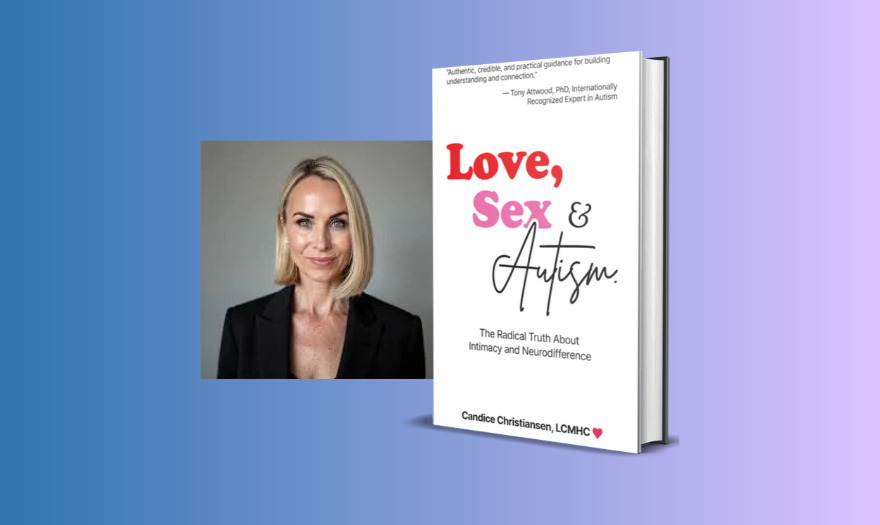
There are not many books that make you want to hand a copy to every clinician, every parent, and every Autistic adult you know. Love, Sex, and Autism is one of them. It arrives at a moment when Autistic adults are increasingly leading the research and the narrative about our own lives, creating space for conversations, like this one, that have been avoided for far too long.
For decades, Autistic people have been described in clinical literature and popular culture alike as non-sexual, emotionally flat, unempathetic, and/or incapable of real relationships and intimacy. It is one of the oldest myths about autism, and also one of the most persistent. These narratives have historically shaped how clinicians are trained and how Autistic adults have come to see ourselves. Candice Christiansen, M.Ed., LCMHC, CSAT-S, wrote this book to dismantle this myth, and she does not do it quietly.
Why This Book Is Different
What makes Love, Sex, and Autism stand out is not just its subject matter. It is the way Christiansen writes about it. She is a clinician with over two decades of experience, plus she is also part of the AuDHD community herself, which means the book reads less like a textbook and more like a conversation with someone who genuinely understands both the research and the lived reality. That combination is rare, and it shows in every chapter.
The book does not shy away from the harder material. Christiansen writes openly about sensory experience in physical intimacy, about the communication mismatches she calls ‘neurolove languages’, and about betrayal, trauma, and sexual behavior that has become unmanageable – all topics that are almost never addressed honestly in autism specific resources. But the book is not heavy for the sake of it. Its core message is hopeful and overdue: Autistic adults are capable of and deserving of love, healthy sex, and intimacy where we get to be fully ourselves.
One chapter I found genuinely important is Chapter 12, “Sex and the Senses.” Christiansen lays out the many ways sensory experience shapes sex and intimacy for Autistics. She writes about Sensory Overload “…sensory overload is more than a matter of personal well-being; it’s a relational skill and one of the foundations of intimacy. Because when we understand our nervous systems, we can start to advocate for the conditions that allow for connection, not through masking, but through safety and choice,” and what she calls Sensory Hygiene, the conditions ”both people need in their sensory environment in order to feel comfortable, calm, and attuned to their bodies, rather than feeling overwhelmed.” In this chapter, Christiansen reframes something many Autistic adults have spent a lifetime masking through as a skill worth naming and building instead. Reading it, I found myself wishing we’d had this language years ago, a way to turn something we only ever experienced privately into something we can actually name and ask for.
She frames understanding your own sensory overload as a relational skill, not just a matter of personal wellbeing, one that lets you advocate for the conditions that allow real connection, ‘not through masking, but through safety and choice.'”
Readers do not just learn about these ideas in the abstract. The book is built to be used, not simply read once and shelved. It moves between case material drawn from Christiansen’s own practice, personal reflection, and direct guidance readers can apply in their own relationships or clinical work. That workbook quality is part of what makes it feel so useful rather than theoretical. It gives clinicians language they can bring into session the same week they read it, and it gives Autistic adults and partners a way to talk about their own experience that may be entirely new to them.
This is exactly the kind of resource our community has been missing. So much of what exists on autism and sexuality was written without Autistic voices involved, and it tends to treat the Autistic partner as the problem to be solved rather than a full person capable of deep connection. Christiansen flips that entirely. She centers the Autistic experience as valid, complex, and worthy of the same nuance any relationship deserves, and she makes room for the full range of how Autistic people experience gender, sexuality, and connection, which is part of what makes the book feel current and practical.
Christiansen’s clinical practice at the Namaste Center for Healing clearly shaped every chapter. She and her team work with Autistic, AuDHD, and ADHD individuals (and couples) and that clinical experience is what makes the guidance feel tested rather than theoretical.
Why It Matters to Our Community
Questions about relationships and intimacy come up constantly in the AANE community. Most clinicians were never taught how to talk about intimacy with Autistic clients in a way that does not default to pathology, and most Autistic adults have spent our lives absorbing the message that we are somehow not built for the “romantic” part of life. Neither of those things has to keep being true.
A book like this does not just fill a gap. It changes the conversation. It gives clinicians a framework grounded in real clinical experience rather than assumption, and it gives Autistic adults something that can be genuinely hard to come by: a resource about our own intimate lives that was not written to explain them to someone else, but to affirm them on our own terms. For partners and family members, it offers a way in as well, a chance to understand intimacy from a Neurodivergent perspective rather than expecting an Autistic loved one to adapt to the neuromajority’s script.
Hear It Directly From Her
AANE is thrilled to welcome Candice Christiansen as the inaugural speaker of AANE’s new Daniel W. Rosenn Autism and Neurodiversity Learning Series this October, where she will bring the ideas from her book directly to our community. She will walk participants through what she calls the four radical truths about autism and intimacy, the intersection of autism with gender fluidity and sexuality, and the range of pleasure landscapes Autistic people actually report experiencing.
If you read one book this year on autism and relationships, make it this one.
And if you want to hear the ideas straight from the person who wrote it, join us on October 22!
Love, Sex, and Autism: Practical Guidance for Authentic Intimacy
October 22, 2026, 12 to 2pm ET/9am-11am PT
2.0 CE credits, co-sponsored with the Massachusetts Psychological Association





Sign Up
Receive emails on events, autism info, and Autistic perspectives