

Mathematica Case Study Highlights LifeMAP’s Client-Driven Coaching Model
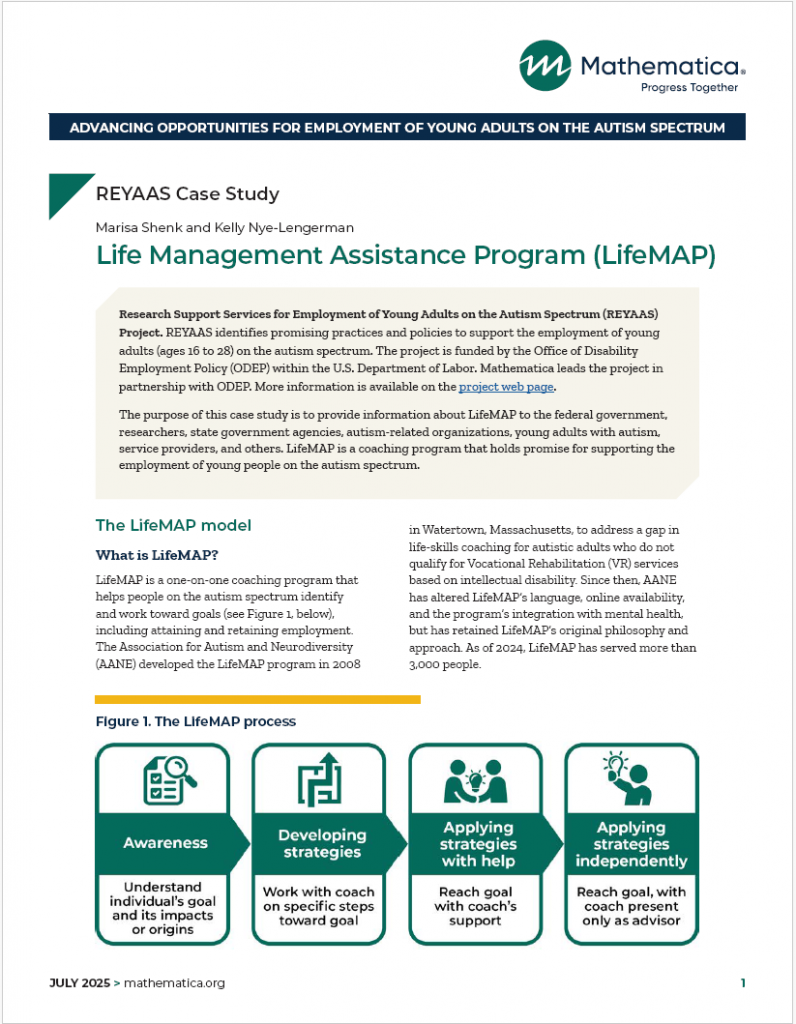

Published by Mathematica in July 2025 for the U.S. Department of Labor’s Office of Disability Employment Policy.
In July 2025, Mathematica published a case study examining AANE’s LifeMAP coaching model, employment-related findings, and lessons learned since the program began in 2008.
Developed through the Research Support Services for Employment of Young Adults on the Autism Spectrum project, the report highlights LifeMAP’s individualized, one-to-one approach to helping Autistic young adults pursue employment and related life goals.
Below is a summary of the key findings and their implications for Autistic adults, families, and professionals.
Below is a summary of the report’s key findings.
About the Research
The report summarizes available program and administrative data. It was not a randomized or controlled evaluation and does not establish that LifeMAP alone caused the reported outcomes.
Within those limitations, the findings provide encouraging evidence and identify LifeMAP as a promising approach that merits continued study.
Key Findings at a Glance
Increased Confidence and Reduced Anxiety
A descriptive analysis examined 264 LifeMAP clients who worked on coaching goals between January 2016 and June 2020.
Clients reported reduced anxiety and increased confidence between the development of their goals and their final goal report.
Promising Employment Findings
Among 170 MassAbility clients referred to LifeMAP in 2023, 40 job placements were reported.
Among clients whose cases had closed, 94% had a successful employment outcome. Clients who became employed worked an average of more than 23 hours per week and earned more than $19 per hour.
Individualized, Client-Driven Coaching
LifeMAP’s client-driven approach means clients choose goals that are meaningful to their own lives and work one-to-one with coaches to develop practical strategies.
LifeMAP staff reported that focusing on each client’s priorities, rather than on goals selected by a coach, teacher, or parent, contributed to stronger engagement and participation in coaching.
More Than a Job Search
Employment goals are often connected to other areas of daily life. Depending on their individual priorities, LifeMAP clients may work on education, executive functioning, communication, emotional regulation, routines, self-advocacy, independent living, and employment within an individualized coaching partnership.
In the analysis of 264 LifeMAP clients:
- 28% had an employment goal.
- 20% had an independent-living goal.
- 15% had an education goal.
- Approximately 10% had goals involving regulation, communication, or self-awareness.
Additional Research on LifeMAP
An Individualized Life-Skills Coaching Program for Adults with Autism
Published in Advances in Autism, this article examines LifeMAP’s individualized coaching structure, client-selected goals, and descriptive findings related to progress toward those goals.
Overview of a Life Skills Coaching Program for Adults on the Autism Spectrum: Coaches’ Perspectives
Published in Psychological Reports, this article explores LifeMAP coaches’ experiences, strategies, training, program support, and perspectives on factors affecting client progress.
2022 Mathematica Literature Review Featuring LifeMAP
Mathematica’s broader review of employment programs identified LifeMAP as an example of an individualized coaching and mentoring model supporting employment-related goals.
Take the Next Step with LifeMAP
LifeMAP offers individualized, one-to-one coaching for Autistic and similarly Neurodivergent adults and older teens.
You do not need to have everything figured out before reaching out. A free LifeMAP call is a low-pressure way to ask questions, share what is going on, and learn whether coaching may be a good fit for you, a family member, or a client.





Sign Up
Receive emails on events, autism info, and Autistic perspectives